How Dayton’s Entrepreneurial Ecosystem Is Powering Fiberless Connectivity
Highlighting the synergy between Dayton Photonics and the Entrepreneurs' Center, this piece explores how Dayton’s innovation ecosystem empowers deep tech startups to bridge the difficult gap between defense research and commercial viability.
Why managing AI risk presents new challenges
Aliquet morbi justo auctor cursus auctor aliquam. Neque elit blandit et quis tortor vel ut lectus morbi. Amet mus nunc rhoncus sit sagittis pellentesque eleifend lobortis commodo vestibulum hendrerit proin varius lorem ultrices quam velit sed consequat duis. Lectus condimentum maecenas adipiscing massa neque erat porttitor in adipiscing aliquam auctor aliquam eu phasellus egestas lectus hendrerit sit malesuada tincidunt quisque volutpat aliquet vitae lorem odio feugiat lectus sem purus.
- Lorem ipsum dolor sit amet consectetur lobortis pellentesque sit ullamcorpe.
- Mauris aliquet faucibus iaculis vitae ullamco consectetur praesent luctus.
- Posuere enim mi pharetra neque proin condimentum maecenas adipiscing.
- Posuere enim mi pharetra neque proin nibh dolor amet vitae feugiat.
The difficult of using AI to improve risk management
Viverra mi ut nulla eu mattis in purus. Habitant donec mauris id consectetur. Tempus consequat ornare dui tortor feugiat cursus. Pellentesque massa molestie phasellus enim lobortis pellentesque sit ullamcorper purus. Elementum ante nunc quam pulvinar. Volutpat nibh dolor amet vitae feugiat varius augue justo elit. Vitae amet curabitur in sagittis arcu montes tortor. In enim pulvinar pharetra sagittis fermentum. Ultricies non eu faucibus praesent tristique dolor tellus bibendum. Cursus bibendum nunc enim.

How to bring AI into managing risk
Mattis quisque amet pharetra nisl congue nulla orci. Nibh commodo maecenas adipiscing adipiscing. Blandit ut odio urna arcu quam eleifend donec neque. Augue nisl arcu malesuada interdum risus lectus sed. Pulvinar aliquam morbi arcu commodo. Accumsan elementum elit vitae pellentesque sit. Nibh elementum morbi feugiat amet aliquet. Ultrices duis lobortis mauris nibh pellentesque mattis est maecenas. Tellus pellentesque vivamus massa purus arcu sagittis. Viverra consectetur praesent luctus faucibus phasellus integer fermentum mattis donec.
Pros and cons of using AI to manage risks
Commodo velit viverra neque aliquet tincidunt feugiat. Amet proin cras pharetra mauris leo. In vitae mattis sit fermentum. Maecenas nullam egestas lorem tincidunt eleifend est felis tincidunt. Etiam dictum consectetur blandit tortor vitae. Eget integer tortor in mattis velit ante purus ante.
- Vestibulum faucibus semper vitae imperdiet at eget sed diam ullamcorper vulputate.
- Quam mi proin libero morbi viverra ultrices odio sem felis mattis etiam faucibus morbi.
- Tincidunt ac eu aliquet turpis amet morbi at hendrerit donec pharetra tellus vel nec.
- Sollicitudin egestas sit bibendum malesuada pulvinar sit aliquet turpis lacus ultricies.
“Lacus donec arcu amet diam vestibulum nunc nulla malesuada velit curabitur mauris tempus nunc curabitur dignig pharetra metus consequat.”
Benefits and opportunities for risk managers applying AI
Commodo velit viverra neque aliquet tincidunt feugiat. Amet proin cras pharetra mauris leo. In vitae mattis sit fermentum. Maecenas nullam egestas lorem tincidunt eleifend est felis tincidunt. Etiam dictum consectetur blandit tortor vitae. Eget integer tortor in mattis velit ante purus ante.
Dayton Ohio has long been a place where breakthrough ideas take shape. From aviation to advanced manufacturing, the region has consistently produced technologies that influence national and global progress. Today, that legacy continues through a new generation of companies working at the intersection of science, infrastructure, and real world impact.
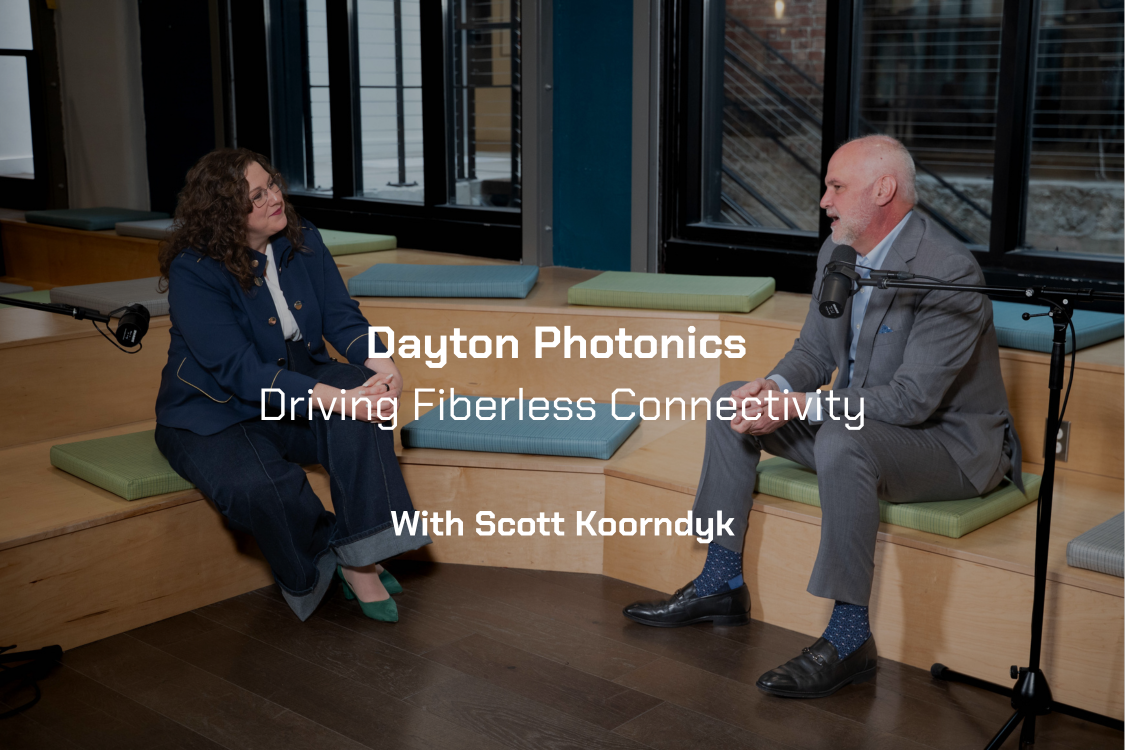
In a recent conversation, CEO Emily Fehrman Cory of Dayton Photonics and Scott Koorndyk, President of the Entrepreneurs' Center, discussed how Dayton’s innovation ecosystem helps deep tech companies move from research to commercialization, and why that journey matters more than ever.
Their discussion highlights how regional support, market understanding, and long term vision are enabling new approaches to broadband connectivity, including fiberless optical systems.
The Entrepreneurs' Center: From Incubator to Innovation Engine
The Entrepreneurs' Center has supported entrepreneurs for more than 25 years. What began as a traditional incubator has evolved into a full service innovation center serving more than 1,100 companies nationwide, with the majority based in Ohio.
Its role extends far beyond physical space. The Entrepreneurs' Center supports founders from company inception through major growth milestones by providing expertise in market development, product strategy, intellectual property, fundraising, and commercialization.
This kind of comprehensive support is especially important for deep tech companies, where scientific excellence alone is not enough to achieve market success.
Founding Dayton Photonics: Starting With the Right Partners
For Dayton Photonics, that support began from day one. As Emily explained, one of the very first calls she made after deciding to start the company was to the Entrepreneurs' Center, shortly after completing the required state filings.
That early partnership proved critical. As Dayton Photonics approaches major milestones, including the close of its seed funding round, the Entrepreneurs' Center has played a key role in helping the team understand fundraising strategy, investor expectations, and market positioning.
For founders coming from research and technical backgrounds, having experienced commercialization partners early can dramatically accelerate progress.
Navigating Dual-Use Technology in a Defense-Rich Region
Dayton’s proximity to Wright Patterson Air Force Base and the Air Force Research Laboratory creates a unique environment for innovation. Many startups in the region, including Dayton Photonics, have deep roots in defense research and federally funded programs such as SBIR.
Dayton Photonics originated from this ecosystem and continues to serve strong defense use-cases. However, as Emily and Scott discussed, long term success requires more than government validation. Companies must also understand and serve commercial markets.
This is where ecosystem partners play a critical role, helping founders bridge the gap between research driven development and customer driven commercialization.
Why Market Research Is the Foundation of Commercial Success
One of the first major projects the Entrepreneurs' Center supported for Dayton Photonics was market research, a step that proved foundational.
In regions like Dayton, where hundreds of defense technologies enter the market each year, it is easy for technologists to focus on innovation for its own sake. Government funding can support early development, but it rarely takes a company all the way to scale.
Market research helps founders answer critical questions. Who is the customer? What problem truly matters? How does the value proposition change outside government contexts?
Understanding industry language, customer priorities, and buying behavior allows companies to align their technology with real world demand.

Translating Technical Excellence Into Customer Value
A key insight from Emily and Scott’s discussion was the difference between how government and commercial customers evaluate technology.
Government stakeholders often focus on scientific advancement and technical novelty. Commercial customers care less about how a solution works and more about whether it works reliably, economically, and at scale.
For Dayton Photonics, this meant learning to shift conversations away from detailed explanations of beam steering technology and toward outcomes such as performance, reliability, deployment speed, and resilience.
This mindset shift, while challenging, is essential for any deep tech company entering commercial markets.
Why Broadband Providers Are Being Forced to Innovate
Their conversation also explored why timing matters. Internet service providers are under unprecedented pressure to expand coverage and improve performance.
A historic federal investment of $42.5 billion in broadband infrastructure has reframed internet access as a utility rather than a luxury. This shift has pushed providers to serve rural and underserved areas that were previously uneconomical.
Physical barriers such as rivers, mountains, railroads, and low population density make traditional fiber deployment difficult. As a result, providers are actively seeking new technologies that can deliver high capacity connectivity quickly and cost-effectively.
Government and Commercial Markets Both Matter
While government sales cycles are long and complex, they offer stability and credibility. Government contracts pay reliably and can open doors across multiple agencies.
As Scott noted, government engagement can provide a stable foundation that allows companies to weather fluctuations in commercial markets.
Commercial customers, in turn, provide private investment and scale opportunities that government funding alone cannot deliver. Successful companies find ways to satisfy both constituencies through targeted research and clear customer insight.
Building Future-Ready Connectivity
Dayton Photonics is applying these lessons as it introduces new fiberless connectivity solutions designed to reach areas previously limited by physical or economic barriers.
By combining advanced optical technology with a deep understanding of the market, Dayton Photonics aims to make high-speed connectivity more accessible, efficient, and resilient.
The conversation between Emily and Scott underscores the importance of strong innovation ecosystems in turning technical potential into real world impact. Through collaboration, research, and a focus on customer value, Dayton Photonics and the Entrepreneurs' Center are helping shape the future of connectivity, starting with Ohio.