Why True Redundancy Requires Diverse Physics (The Swiss Cheese Model)
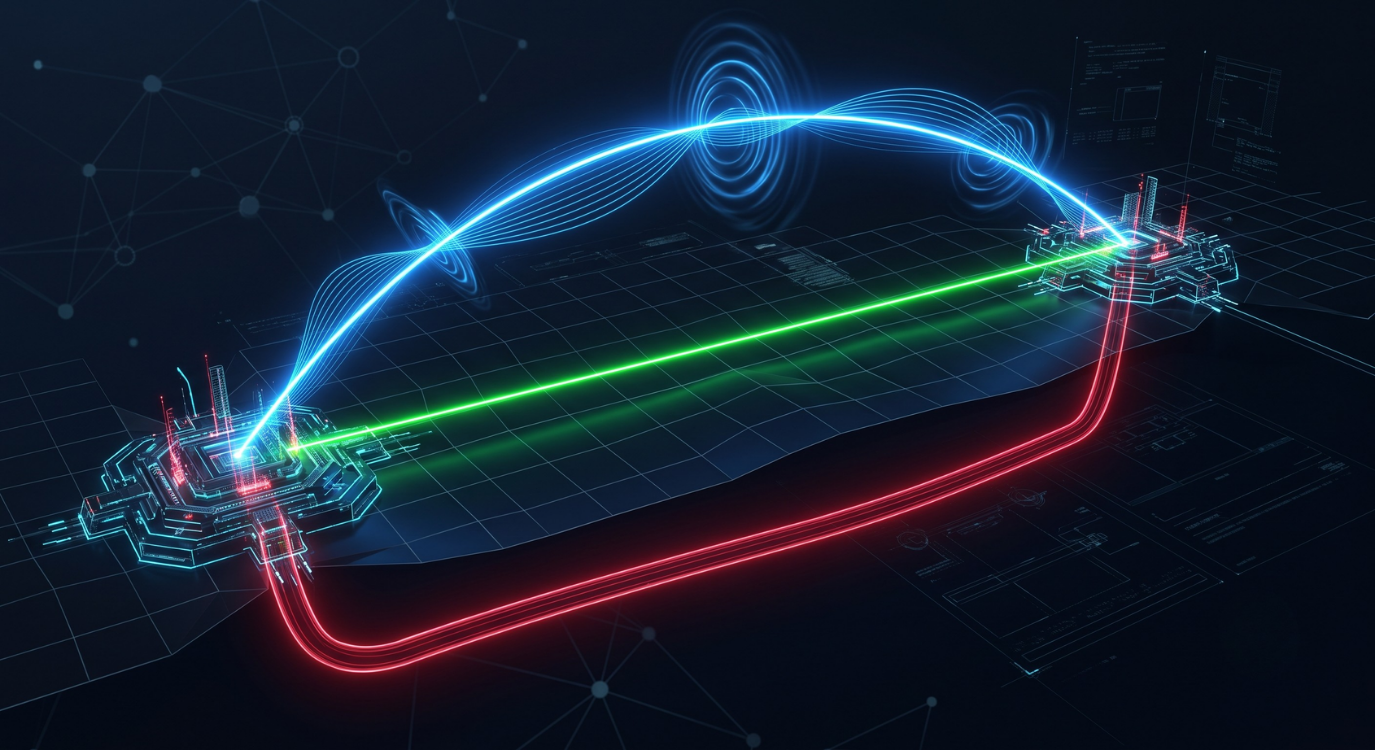
True network redundancy requires combining physically diverse mediums like fiber, RF, and fiberless optics to eliminate overlapping failure points.
- Standard fiber and RF backups have environmental vulnerabilities that can lead to failures.
- Fiberless Optics operate on an independent physical plane immune to ground and radio threats.
- Diverse physical architecture ensures organizations satisfy strict compliance audits and maintain constant uptime.
Why managing AI risk presents new challenges
Aliquet morbi justo auctor cursus auctor aliquam. Neque elit blandit et quis tortor vel ut lectus morbi. Amet mus nunc rhoncus sit sagittis pellentesque eleifend lobortis commodo vestibulum hendrerit proin varius lorem ultrices quam velit sed consequat duis. Lectus condimentum maecenas adipiscing massa neque erat porttitor in adipiscing aliquam auctor aliquam eu phasellus egestas lectus hendrerit sit malesuada tincidunt quisque volutpat aliquet vitae lorem odio feugiat lectus sem purus.
- Lorem ipsum dolor sit amet consectetur lobortis pellentesque sit ullamcorpe.
- Mauris aliquet faucibus iaculis vitae ullamco consectetur praesent luctus.
- Posuere enim mi pharetra neque proin condimentum maecenas adipiscing.
- Posuere enim mi pharetra neque proin nibh dolor amet vitae feugiat.
The difficult of using AI to improve risk management
Viverra mi ut nulla eu mattis in purus. Habitant donec mauris id consectetur. Tempus consequat ornare dui tortor feugiat cursus. Pellentesque massa molestie phasellus enim lobortis pellentesque sit ullamcorper purus. Elementum ante nunc quam pulvinar. Volutpat nibh dolor amet vitae feugiat varius augue justo elit. Vitae amet curabitur in sagittis arcu montes tortor. In enim pulvinar pharetra sagittis fermentum. Ultricies non eu faucibus praesent tristique dolor tellus bibendum. Cursus bibendum nunc enim.

How to bring AI into managing risk
Mattis quisque amet pharetra nisl congue nulla orci. Nibh commodo maecenas adipiscing adipiscing. Blandit ut odio urna arcu quam eleifend donec neque. Augue nisl arcu malesuada interdum risus lectus sed. Pulvinar aliquam morbi arcu commodo. Accumsan elementum elit vitae pellentesque sit. Nibh elementum morbi feugiat amet aliquet. Ultrices duis lobortis mauris nibh pellentesque mattis est maecenas. Tellus pellentesque vivamus massa purus arcu sagittis. Viverra consectetur praesent luctus faucibus phasellus integer fermentum mattis donec.
Pros and cons of using AI to manage risks
Commodo velit viverra neque aliquet tincidunt feugiat. Amet proin cras pharetra mauris leo. In vitae mattis sit fermentum. Maecenas nullam egestas lorem tincidunt eleifend est felis tincidunt. Etiam dictum consectetur blandit tortor vitae. Eget integer tortor in mattis velit ante purus ante.
- Vestibulum faucibus semper vitae imperdiet at eget sed diam ullamcorper vulputate.
- Quam mi proin libero morbi viverra ultrices odio sem felis mattis etiam faucibus morbi.
- Tincidunt ac eu aliquet turpis amet morbi at hendrerit donec pharetra tellus vel nec.
- Sollicitudin egestas sit bibendum malesuada pulvinar sit aliquet turpis lacus ultricies.
“Lacus donec arcu amet diam vestibulum nunc nulla malesuada velit curabitur mauris tempus nunc curabitur dignig pharetra metus consequat.”
Benefits and opportunities for risk managers applying AI
Commodo velit viverra neque aliquet tincidunt feugiat. Amet proin cras pharetra mauris leo. In vitae mattis sit fermentum. Maecenas nullam egestas lorem tincidunt eleifend est felis tincidunt. Etiam dictum consectetur blandit tortor vitae. Eget integer tortor in mattis velit ante purus ante.
We’ve all heard the promise of "Five-Nines Availability." In the world of mission-critical networking, it’s the gold standard we all strive for. But as any seasoned operations leader knows, a single, flawless technology does not exist. Every medium—no matter how advanced—has an inherent vulnerability dictated by its underlying physics.
If your organization manages critical systems where failure is simply not an option, you already know you need redundancy. In many highly regulated industries, a strict level of backup infrastructure is even legally mandated.
But here is the catch: If your primary and secondary systems share the same vulnerabilities, you don’t actually have redundancy. You have a false sense of security.
To build a network that minimizes common failures as much as possible, enterprise architects must view their infrastructure through a classic risk-management framework: The Swiss Cheese Model.
Understanding the "Swiss Cheese" Model of Network Security
Originally developed for aviation and safety science, the Swiss Cheese Model likens an organization's defenses to a stack of cheese slices. Each slice represents a different layer of technology or defense.
Every technology has "holes"—inherent weak points where it is prone to failure. The goal of a resilient system isn't to find a magical piece of cheese without holes; the goal is to stack your slices so that the holes never overlap. You want to block the vulnerability of one medium with the distinct physical strength of another.
When we look at traditional enterprise networking, the two dominant players are physical fiber and wireless (RF). Both are incredible technologies, but their physical limitations overlap in dangerous ways:
- Physical fiber is fast and reliable—until it isn’t. It is entirely vulnerable to ground-level disruptions. A rogue backhoe at a nearby construction site, a severe weather event, or a simple accidental line cut can instantly sever a primary connection.
- Wireless RF networks bypass ground-level disruptions, but they introduce their own distinct holes: spectrum congestion, weather-induced rain fade, physical interference, and vulnerability to localized jamming.
The Redundancy Illusion: If your backup strategy simply involves running a second fiber line through the same metropolitan conduit, or relying on an RF link that shares a congested airspace, a single localized incident can take down both lines simultaneously.
Enter Theia: Redundancy Rooted in Diverse Physics
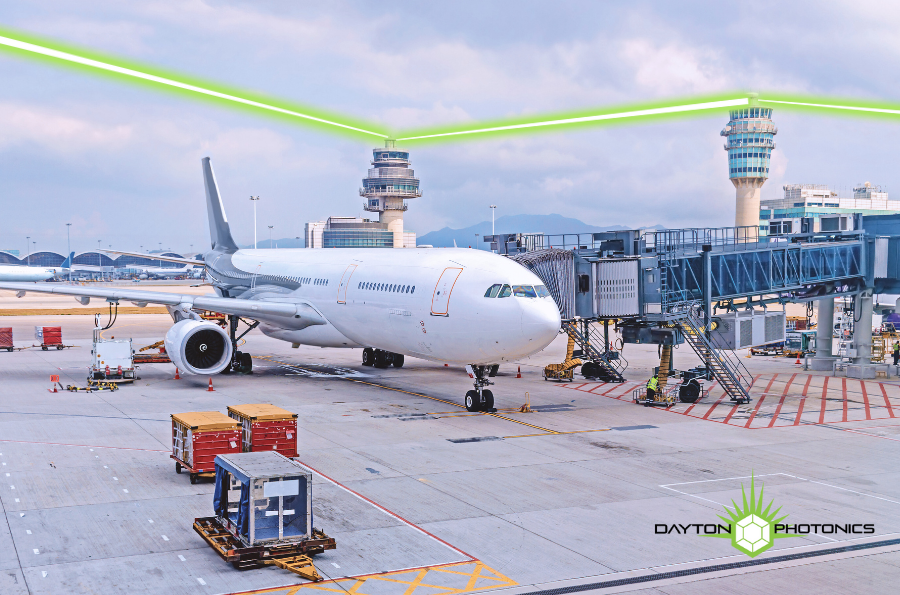
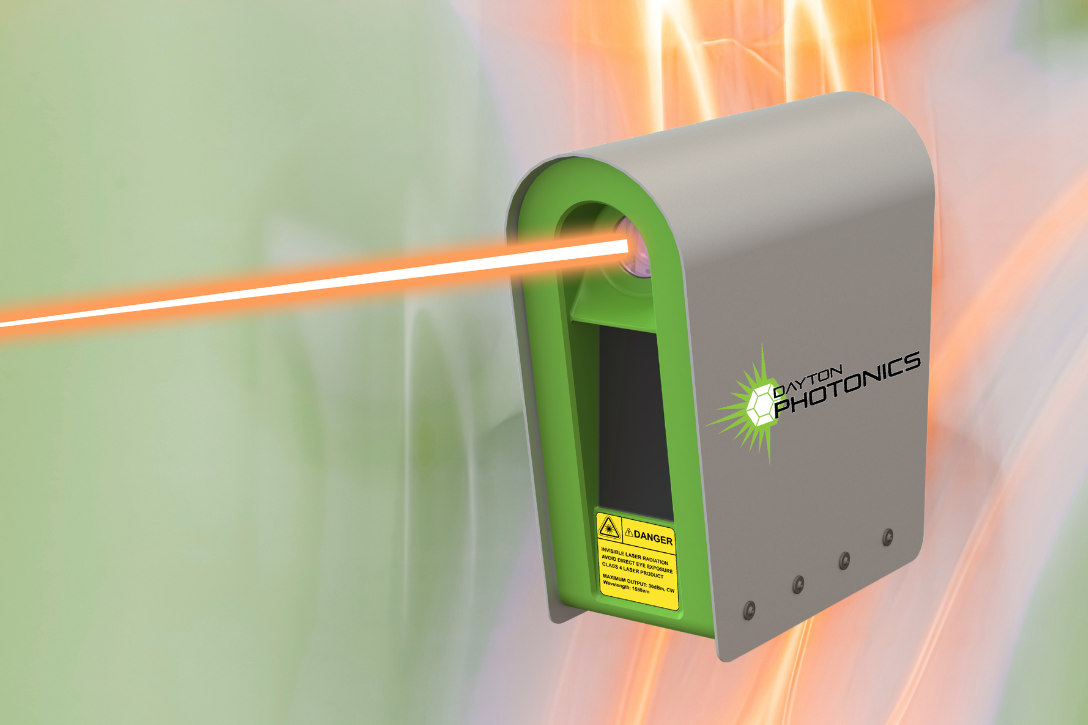
At Dayton Photonics, we designed Theia to be the ultimate complementary layer to your existing enterprise infrastructure. Theia doesn’t compete with fiber or RF; it secures them. Theia™ was designed to complement—not replace—fiber and RF transport.
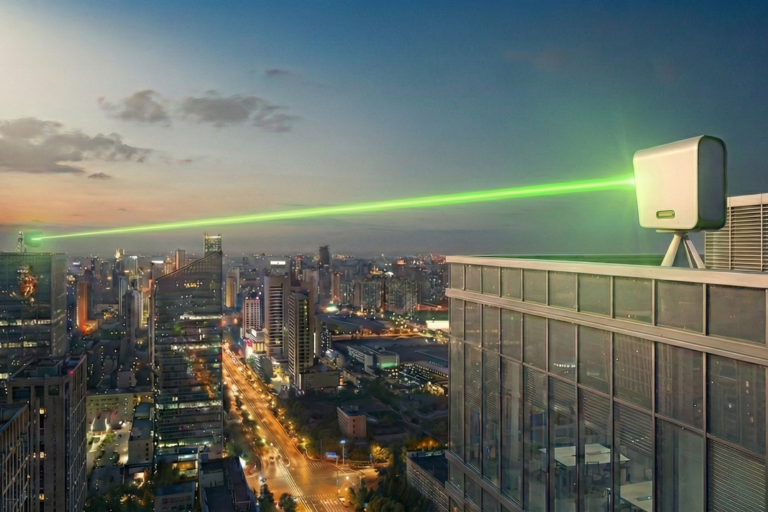
Because Theia utilizes laser-based Fiberless Optic (AKA free-space optics), its failure modes are completely independent of both the ground and the radio spectrum. It operates on a completely different plane of physics.
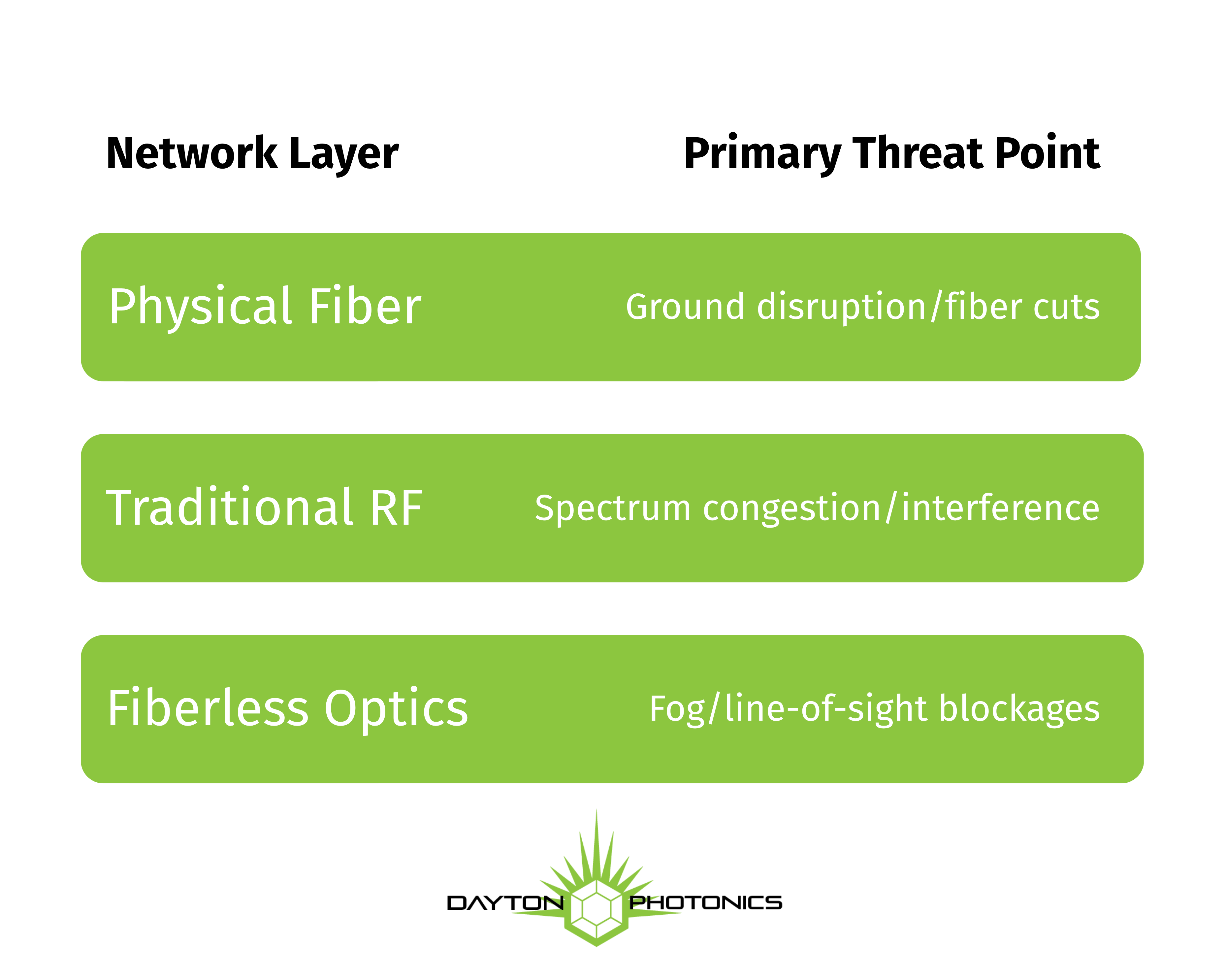
The Result: Zero Overlapping Vulnerabilities = True High-Availability
If a construction crew cuts your primary fiber line, your RF network might struggle under the sudden data reroute. But Theia’s fiberless laser link—unaffected by ground disruptions and entirely immune to RF spectrum interference—remains completely clear. By layering Theia into your stack, you successfully plug the holes of legacy systems.
The High Stakes of True Resilience: Compliance and SLAs
For modern enterprises, defense sectors, industrial automation, and municipal infrastructure, network downtime is measured in thousands of dollars per minute—or worse, compromised safety.
Because the stakes are so high, modern regulatory frameworks and strict Service Level Agreements (SLAs) increasingly mandate true, independent redundancy. Auditors and compliance officers are looking closer at network architecture than ever before. They are no longer checking a box just because you have a "backup line." They are asking:
- Is your backup truly diverse?
- If the primary path fails, will the secondary path survive the exact same localized event?
Deploying Theia allows organizations to confidently hit those rigorous compliance standards and guarantee "high-nines" availability. Because it doesn’t rely on the same physical pathways or the same spectrum assets as your primary links, it satisfies the most stringent path-diversity requirements.
Future-Proof Your Network
True operational resilience isn't about buying more of the same hardware or doubling down on a single medium. It’s about thinking strategically about the vulnerabilities in your stack and ensuring your defense layers are physically distinct.
If you are relying on overlapping technologies, your network might be more fragile than you think.
Want to see how Theia can plug the holes in your current infrastructure? Contact the team at Dayton Photonics today to discover how we can help you achieve true, unshakeable redundancy. Sales@Dayton-Photonics.com.